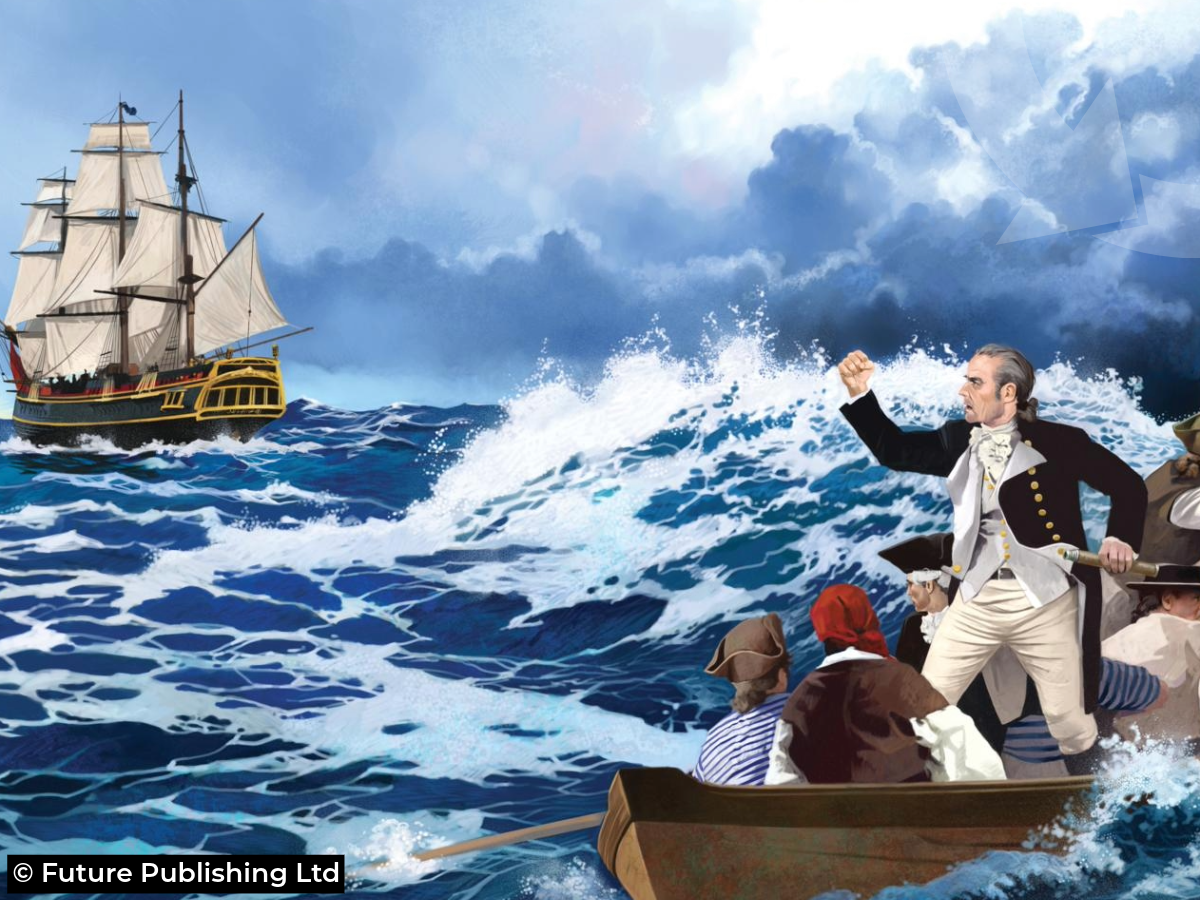
How a British Royal Navy crew turned on Captain William Bligh and how he and his allies survived their journey to safety
The mutiny aboard the HMS Bounty in 1789 is one of the most famous in the history of the British Navy. What brought the mutiny about in some ways reflects the social and economic struggles of the era, taking place, as it did, about a week before the French Revolution kicked off.
The HMS Bounty was a British Royal Navy vessel set for Tahiti in 1787. Its mission, recommended by Captain James Cook, was to collect breadfruit from the island, a starchy fruit that has a bready texture when cooked. The Bounty was expected to collect this fruit and then transport it to the West Indies where it would be used as food for enslaved people there.
The initial voyage to Tahiti took ten gruelling months in which the ship’s captain, Lieutenant William Bligh, did little to ingratiate himself with his 43-man crew. Bligh had a reputation as a cruel taskmaster and there was increasing discontent among some on board, not least master’s mate Fletcher Christian. This situation wasn’t made any better when they finally arrived in Tahiti only to find that the fruit was out of season and could not be collected.
The decision was made to remain on the island for five months to wait for the fruit to be ripe for picking. In that time the crew of the Bounty made lives for themselves among the Tahitians, many of the men taking Tahitian partners and enjoying the freedom of the island. That’s to say nothing of the relative quality of life, even compared to their experiences back in England. So, when the time came to harvest the fruit and continue their voyage towards the West Indies, tempers flared.
Returning to ship discipline proved difficult for many and the frictions that had been building before landing at Tahiti came to the fore once more. 23-days into their journey, on 28 April 1789, and about 2,100 km (1,300 miles) from the Tahitian shore, Fletcher Christian led a small coterie of mutineers to the sleeping Bligh’s quarters and directed him at bayonet point to the deck. With no marines on board Bligh had little protection against the mutiny. Of the 43 men aboard, Christian had 18 on his side, 22 loyal to Bligh and two apparently abstaining from giving an opinion.
18 of the loyal crew were placed in the Ships Launch, a relatively small, open boat. Four loyalists were held on the ship to keep it sailing as the mutineers made their way back to Tahiti. There some attempted to continue their island lives, although others, including Christian, feared retribution from the Royal Navy and continued on to Pitcairn Island with some Tahitian men and women. The HMS Bounty was destroyed once they landed and in-fighting soon saw many of the mutineers killed, likely including Christian. However, a community at Adamstown was established and ancestors of the mutineers still live on the island. 14 of the remaining mutineers were captured, but some died as the ship carrying them back to England sank near the Great Barrier Reef. Ultimately four were acquitted, three pardoned and three hanged.
And what happened to Bligh? Remarkably, with a magnetic compass, sextant, quadrant and books of astronomical and geographic information, he was able to navigate the small boat and his men across the vast Pacific to the island of Tofua, where they could resupply. However the locals were reluctant to allow them to leave and the quartermaster was stoned to death as he attempted to free the launch, allowing the others to escape. They then journeyed through storms and cold weather to reach Timor on 14 June where they could send word to British authorities and be picked up. Their journey spanned 3618 nautical miles or 6,700km across 47 days.
The All About History Archive contains more than 600 images like the one above and hundreds of accompanying features examining world history from ancient Egypt to the Cold War. More assets and articles are being added all the time. To search and purchase images directly from the Image Archive, please register here.

Jonathan is the Editor of All About History magazine, running the day to day operations of the brand. He has a Bachelor’s degree in History from the University of Leeds. He has previously worked as Editor of video game magazines games™ and X-ONE and tech magazines iCreate and Apps.
Subscribe to
All About History now for amazing savings!

Follow All About History on…